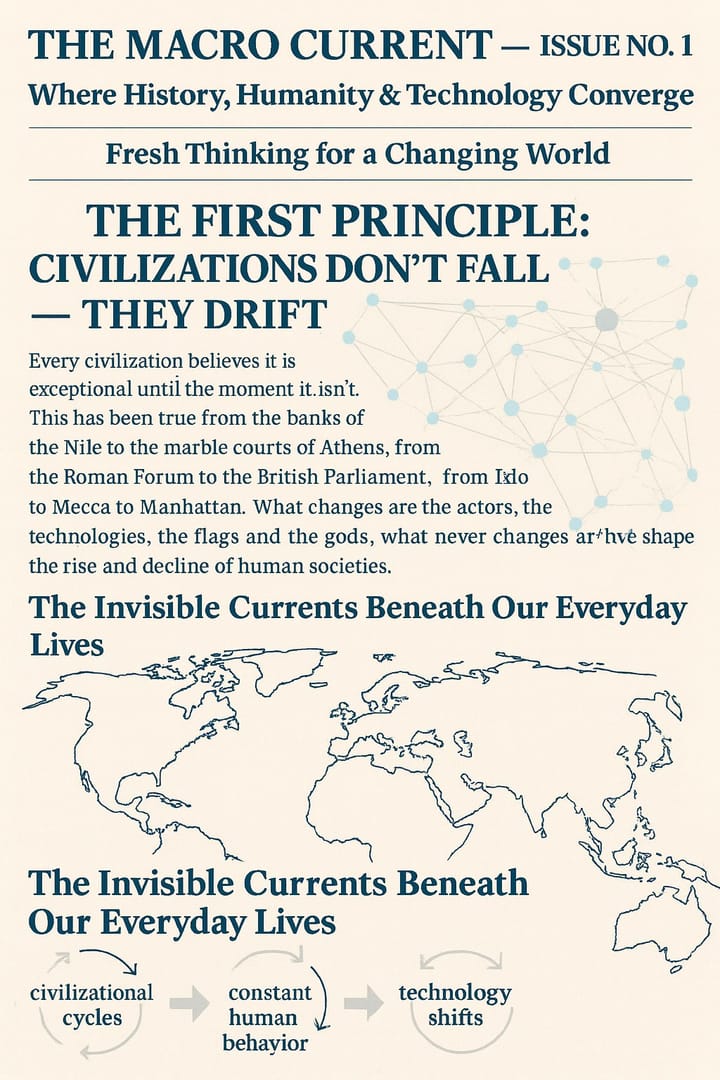
The First Principle: Civilizations Don’t Fall — They Drift
Every civilization believes it is exceptional until the moment it isn’t.
This has been true from the banks of the Nile to the marble courts of Athens, from the Roman Forum to the British Parliament, from Edo to Mecca to Manhattan. What changes are the actors, the technologies, the flags and the gods; what never changes are the underlying forces that shape the rise and decline of human societies.
I learned this not from textbooks, but from my father.
An Accountant, and a Boy Scout raised in pre-independence Nigeria, he taught me — long before I could fully understand it — that the arc of civilization is not random. There are patterns to it. Discipline to it. Consequences to it.
Later, studying religion at the University of Kansas and behavioral economics at Chicago Booth, I began to see the connections between ancient myths, modern incentives, and the systems that hold societies together — or quietly tear them apart. And after two decades working across global infrastructure, healthcare, and technology, I learned something simple but profound:
Human beings build systems… and those systems eventually reshape the humans who built them.
We forget this at our own peril.
The Invisible Currents Beneath Our Everyday Lives
The headlines tell us what happened.
The markets tell us how people reacted.
But neither tells us why.
Why are institutions losing legitimacy?
Why is technology outpacing our moral vocabulary?
Why are global migration patterns reversing?
Why do old alliances fracture while new ones form in unexpected places?
Why do once-mighty nations lose their footing even as others rise?
These questions cannot be answered by news cycles.
They can only be answered by understanding the deeper currents:
- Civilizational cycles that repeat across centuries
- Human behavior that stays constant across cultures
- Technology shifts that reorganize power
- Economic incentives that reward or punish adaptation
- Moral and cultural narratives that bind people together — or tear them apart
This is where The Macro Current begins.
Not with the noise on the surface, but with the forces underneath.
Why This Moment in History Matters More Than Most
We are living through a rare inflection point — a convergence of three once-in-a-century transitions:
- A civilizational power shift:
The U.S. remains powerful, but the structural signals of late-cycle decline are visible. At the same time, countries across the Global South are awakening, protesting, restructuring, and reclaiming agency — from Nepal to Nigeria to Latin America. - A technological reordering:
AI, semiconductors, and bio-technologies are not just tools. They are rewiring the foundations of labor, security, healthcare, migration, and geopolitical power. - A psychological realignment:
People are questioning everything — institutions, identities, economies, and the social contracts that once held nations together.
These forces don’t converge often.
And when they do, civilizations transform.
Some rise to the challenge.
Others drift, unaware that the tide has already pulled them out to sea.
Why I’m Writing This Now
Because I believe we need a new kind of thinking — thinking that is:
- historically literate
- globally informed
- technologically grounded
- human-centered
- behaviorally realistic
- morally humble
And rooted not in ideology, but in clarity.
I’m writing this for anyone who wants to see beyond the surface — founders, policymakers, immigrants, executives, students, technologists, community builders, and everyday people trying to understand the world their children will inherit.
What You Can Expect From The Macro Current
Each issue will explore questions that matter for the next 50–100 years:
- What causes civilizations to decline — and can America correct course?
- Will AI strengthen human agency or undermine it?
- How will demographic shifts reshape the world economy?
- Why are emerging markets asserting themselves, and what comes next?
- What does it take to build resilient institutions in a fractured age?
- How should leaders navigate complexity when the map is missing?
- What must we understand about human behavior to avoid past mistakes?
Some essays will use history to illuminate the present.
Others will decode technology.
Others will explore psychology, culture, economics, or power.
But all will aim for one thing:
To help us think more clearly about the forces shaping our world — and how we can shape it in return.
A Closing Thought for Issue No. 1
Civilizations do not collapse suddenly.
They erode quietly, through drift rather than drama.
But they can also renew themselves — if they have the wisdom to see their reflection honestly, and the courage to act before the tide fully turns.
My goal with The Macro Current is not to predict the future.
It is to illuminate the forces that will define it.
Welcome to the journey.
Let’s think boldly. Let’s see farther.
Let’s stay awake in a world that is changing faster than ever.
— Bayo Adebogun
Founder, VortEdge Inc.
Writer, The Macro Current