The Macro Current: Weekly Signal
Week 2 | March 2026

The SaaS Repricing and the Shift in Value
Understanding what happens when software is no longer the constraint
The Signal
Software markets are being repriced.
What some are calling the “SaaS selloff” reflects a broader shift in how value is being evaluated across technology companies. At the same time, private credit markets—many of which financed software expansion in the post-COVID period—are entering a more uncertain phase as loans mature under tighter financial conditions.
This is unfolding alongside a more complex macro environment:
- The Federal Reserve is holding rates steady, balancing inflation risks against potential weakness in employment
- Energy markets remain unstable due to geopolitical tensions, including disruptions around the Strait of Hormuz
- Credit availability is tightening as investors reassess risk
- Consumer demand is temporarily supported by tax refund season, but underlying pressures remain
At the same time, advances in AI are beginning to change how work is performed.
Tasks that once required large teams and extended timelines are now being completed with significantly fewer resources and in far less time.
The shift is no longer theoretical.
It is being reflected in both markets and operations.
The Mechanism
The current repricing can be understood through a shift in constraints.
For much of the past decade, software solved a key bottleneck: access to tools and coordination of work. SaaS companies scaled by expanding seats, embedding workflows, and increasing dependence on their platforms.
AI is now reducing that constraint.
Agentic systems can perform tasks that previously required:
- multiple roles
- extended coordination
- significant time investment
As a result, the relationship between software and labor is changing.
Work is being compressed.
Teams are becoming smaller.
The cost of execution is declining.
This does not eliminate the need for software, but it changes where value sits.
The bottleneck is no longer access to tools.
It is the ability to ensure that work is executed reliably.
The Framework
This shift aligns with a broader pattern of scarcity migration.
When one constraint is removed, another becomes dominant.
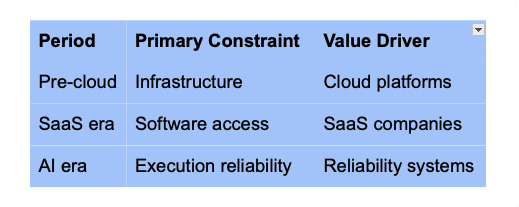
As intelligence becomes more accessible, the challenge shifts from generating insight to ensuring consistent outcomes.
This reflects a core principle:
Systems do not fail because they lack information.
They fail when they cannot act on it reliably.
Structural Implication
The repricing of SaaS is not simply a valuation adjustment.
It reflects a deeper transition in how markets assess risk and durability.
Three dynamics are converging:
- Technology
AI is reducing the cost of performing work and weakening the link between software usage and headcount. - Finance
Private credit that supported software expansion is facing tighter conditions as interest rates remain elevated and refinancing becomes more complex. - Institutions
Policymakers are navigating a more uncertain environment, balancing inflation, employment, and external shocks such as energy supply disruptions.
Together, these forces increase system complexity.
When complexity rises, reliability becomes the scarce and valuable layer.
Markets begin to differentiate between:
- systems that generate activity
- and systems that produce consistent outcomes
Closing Observation
The market is not rejecting software.
It is reassessing what software is worth when the cost of doing work falls.
As execution becomes easier, the challenge shifts to ensuring that execution happens consistently and produces the intended result.
In that environment, value does not disappear.
It moves.
From systems that support work
to systems that ensure work gets done
When the constraint shifts, value follows.
And in the AI era, reliability is where it is moving.
The Macro Current
Where economics, technology, and institutions converge.